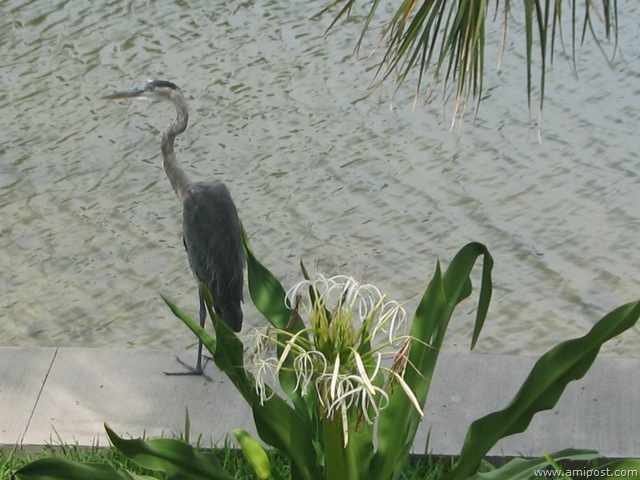
Anna Maria in September is usually one of the quietest months of the year, in terms of entertainment and special events. At this time of year much of our entertainment comes from watching the flowers grow, and watching the birds watching the fish.
That’s because, in terms of weather, it is likely to be one of the most active months of the year. It is the peak of hurricane season. It’s still very hot and humid and buggy. It’s likely to be very rainy because the sea breezes from Florida’s east coast and west coast tend to collide along our shoreline at this time of year. The result is turbulence: thunder and lightning. Floridians who want to discourage repeat houseguests have learned to invite them in the month of September. Often, the weather will take care of the rest and those guests will not ever come back.
October is the month in which we finally get some relief from the heat. As the temperatures drop, and the threat of storms lessens, the island starts to come outside to celebrate the joys of life here. One of the first celebrations of the season is Bayfest, on Pine Avenue in Anna Maria. Now in its ninth year, Bayfest will be held this 2009 on the weekend of October 16. On Friday night, the kick-off party will feature live music by Bootleg from 7 to 10, with DJ Mike Sales.
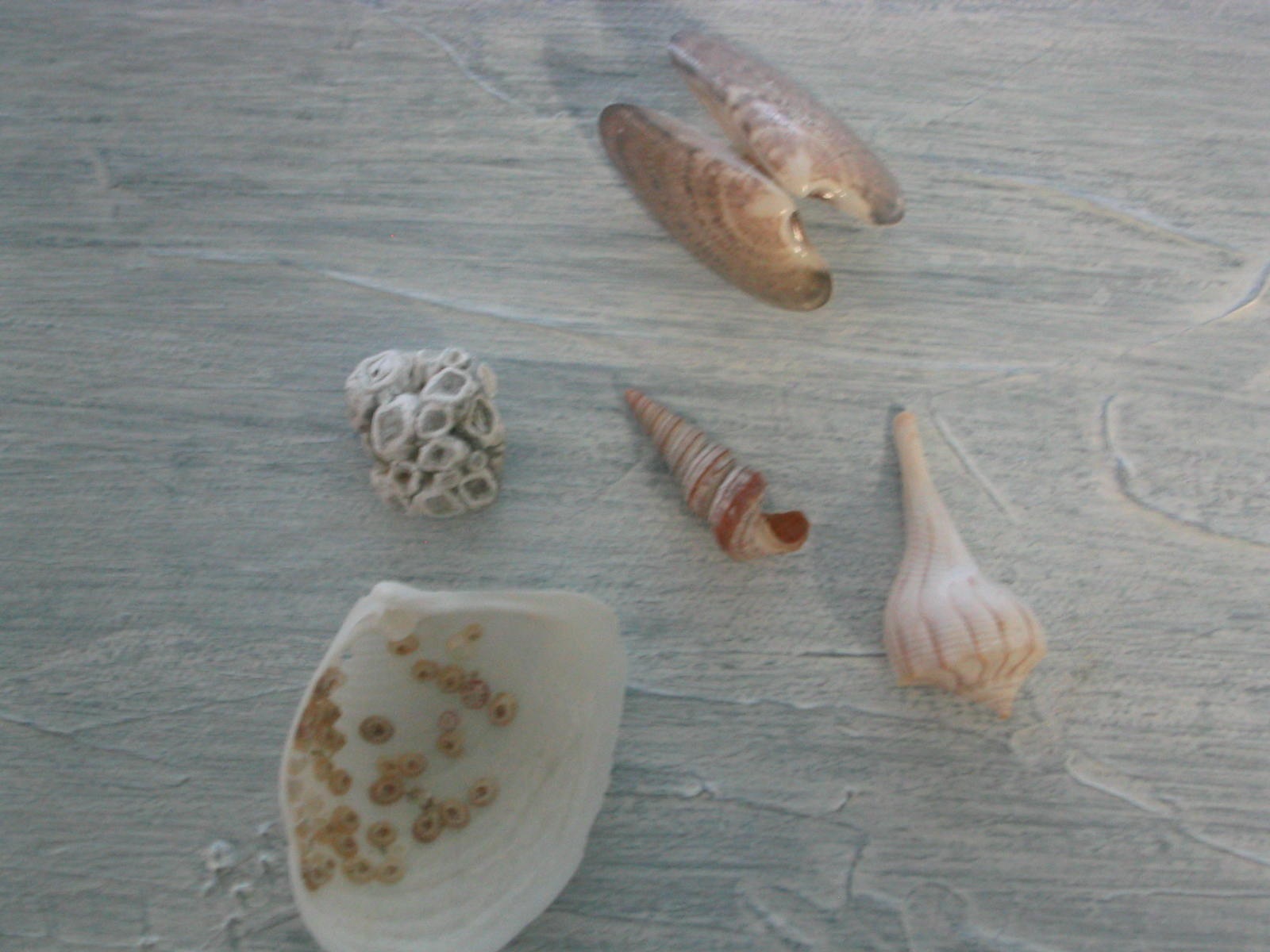
Every evening we walk several blocks across Anna Maria Island to the Gulf Beach, where we walk along the water’s edge as the sun approaches the horizon. It’s always interesting to notice what kinds of shells are on the beach at certain times. There are some “regulars,” which are almost always there. And there are some very unusual ones that show up only every once in awhile. But even the unusual ones tend to come in groups. In other words, if there is one, there are many. This happened one evening several years ago when there were beautiful shark’s eyes suddenly on the beach in large numbers.
The shells that usually wash ashore on the beaches of Anna Maria Island include spiny jewelboxes, which are white with spikes protruding. They look like bivalves, but are, in fact gastropods. Another fairly common gastropod shell is the lettered olive, which usually measures almost 2 inches long. We also come across Florida augers quite often, which are small cone-shaped shells.
A wide variety of bivalve shells is also seen at all times. One of the most interesting and charming is the little coquina, which comes in a wide range of pastels and earth tones. There is nothing more enchanting than seeing the live creatures in tidal pools, where they move with the inflow and outflow of the water. Little cat’s paws or kitten’s paws, range in color from white to black to orange. Jingles are translucent shells that come in these same three colors. About the size of a quarter, these round shells look like they’re made of mica.
There are several bivalves with remarkable patterns on them. Although it’s not unusual to see these shells, it is unusual to find one that is not worn. The sunray Venus may be the most beautiful of these shells, with a pattern that really does give the impression of sunrays. Both calico clams and calico scallops are quite common, too. The buttercup has an appealing smooth round shape, and is the color of butter. Less beautiful but more remarkable is the turkey wing, with one very straight edge and an otherwise roughly shaped surface, striped with brown.
Sometimes at this time of year, the residents of Anna Maria Island begin to feel as if they are operating bed and breakfasts. One set of guests leaves and there is barely time to wash and dry the sheets before the next visitors arrive. It is no wonder friends and family from up North want to visit paradise at this time of year but, while the guests are reveling in paradise, their hosts can start to feel as if it’s “paradise lost.” A constant stream of even the most considerate visitors can hinder residents from focusing on their own favorite island activities. Before they know it, the best season is over and it’s time to turn on the air conditioning and retreat inside.
There are many ways to cope with living in a place everyone else wants to visit. One Islander, formerly of Chicago, sent a card to all his friends when he moved here, announcing that they were welcomed to visit in Anna Maria Island, but only if they had previously visited him in Chicago. This was the acid test to prove that the guests were not just using the friendship as an excuse to have free accommodations in paradise. If they really were visiting for reasons of friendship, they would have visited in Chicago, too.
Another way to cope with having too much company is to not have a guest room. Silly as this may sound, it seems to be a possibility that many islanders have seriously considered. They talk openly about it. In fact, in early years, when researching accommodations for guests at the island information center, I explained to the sweet ladies working there that I had no extra room for guests, but that we were planning to build an addition for this purpose. I was surprised to be sternly advised by one of the ladies not to add a room for guests, or I’d be sorry. Maybe she was just trying to promote more business for the island hotels and motels. But I had the feeling she was giving me a sincere warning.
For years, people arriving on Anna Maria Island via any of the bridges have had a wonderful close-up view of the water along the way. In fact, many of the island’s more laid-back residents and visitors express their welcoming of bridge openings, as opportunities to enjoy the beauty of the surroundings. They don’t mind pausing for a few minutes to appreciate the place in which they have chosen to spend time.
Although the Anna Maria Island Bridge on Manatee Avenue has recently been repaired and restored to last another ten years, there already is a major bureaucratic process underway to determine the ultimate future of this bridge. In fact, what happens to the bridge ten years from now is almost settled.
On March 26, at St. Bernard Catholic Church in Holmes Beach , the FDOT held the final hearing at which they received public input on options for the Anna Maria Island Bridge ’s future. In addition to filling out questionnaires and comment sheets at the hearing, members of the public spoke and their comments were incorporated into the permanent public record. Those who did not attend the hearing can still enter their feedback into the public record by filling out questionnaires and comment sheets and submitting them to the FDOT by April 9. These forms can be downloaded from the site www.annamariaislandbridge.com. Input also can be given by phoning 863-519-2293.