Categories
Tourism

Anna Maria Island Beach Update: Still No Oil Here

The oil from BP’s drilling disaster is still spewing almost 400 miles to the northwest of Anna Maria Island, but it still has not reached our beautiful white beaches. Our feeling of appreciation for these beaches has been heightened as we think the unthinkable: that our abundant wildlife and beautiful clear water and white sand beaches could be seriously harmed by the catastrophe that is doing so much harm to the environment north of us.

Signs that islanders cherish our special beaches are apparent as the holiday weekend approaches here. In particular, there is a new group in Anna Maria called NEMO (North End Merchants Organization), which is planning an extensive trash clean up on July 5, after the anticipated dumping of trash on the beaches by thoughtless visitors. Volunteers will meet at the Roser Community Church, at Ginny’s and Jane’s at the Old IGA, and at Crosspointe Fellowship Church at the south border of the city of Anna Maria. Each group will focus on a particular stretch of beach within Anna Maria.

oil-free Anna Maria beach In addition to this organized effort, there likely will be many individual volunteers who just naturally take it upon themselves to walk the beach with large garbage bags after the fourth, picking up the debris and litter. In past years, members of Anna Maria Island Turtle Watch have been particularly generous in performing this task, not only after the holiday, but in the course of their activities through the entire sea turtle nesting season. Turtles and birds can be badly injured or die from ingesting plastic, or from becoming tangled in it.

Categories
Environment News Tourism

Oil Spill Meeting at Anna Maria Island Community Center

The pristine beauty of Anna Maria Island’s beautiful clean white-sand beaches is something that thousands of local people and visitors care very much about. Although the oil spill occurred almost 400 miles from our beaches, and although there is no oil near our shores, it is worth being prepared to act in case the oil comes our way.

Anna Maria Beach

On Thursday evening, June 17, islanders concerned about the oil in the Gulf gathered in large numbers at the Anna Maria Island Community Center at 407 Magnolia Avenue in Anna Maria. The streets around the center were lined with parked cars, and the crowd of hundreds filled the gymnasium, including the bleachers.

A large panel of speakers and representatives of various public and private organizations sat at a long table. A big projector screen showed the face of the speaker as well as slide presentations throughout the evening.

Categories
Environment

What Not to Collect on Anna Maria Island: Live Sand Dollars

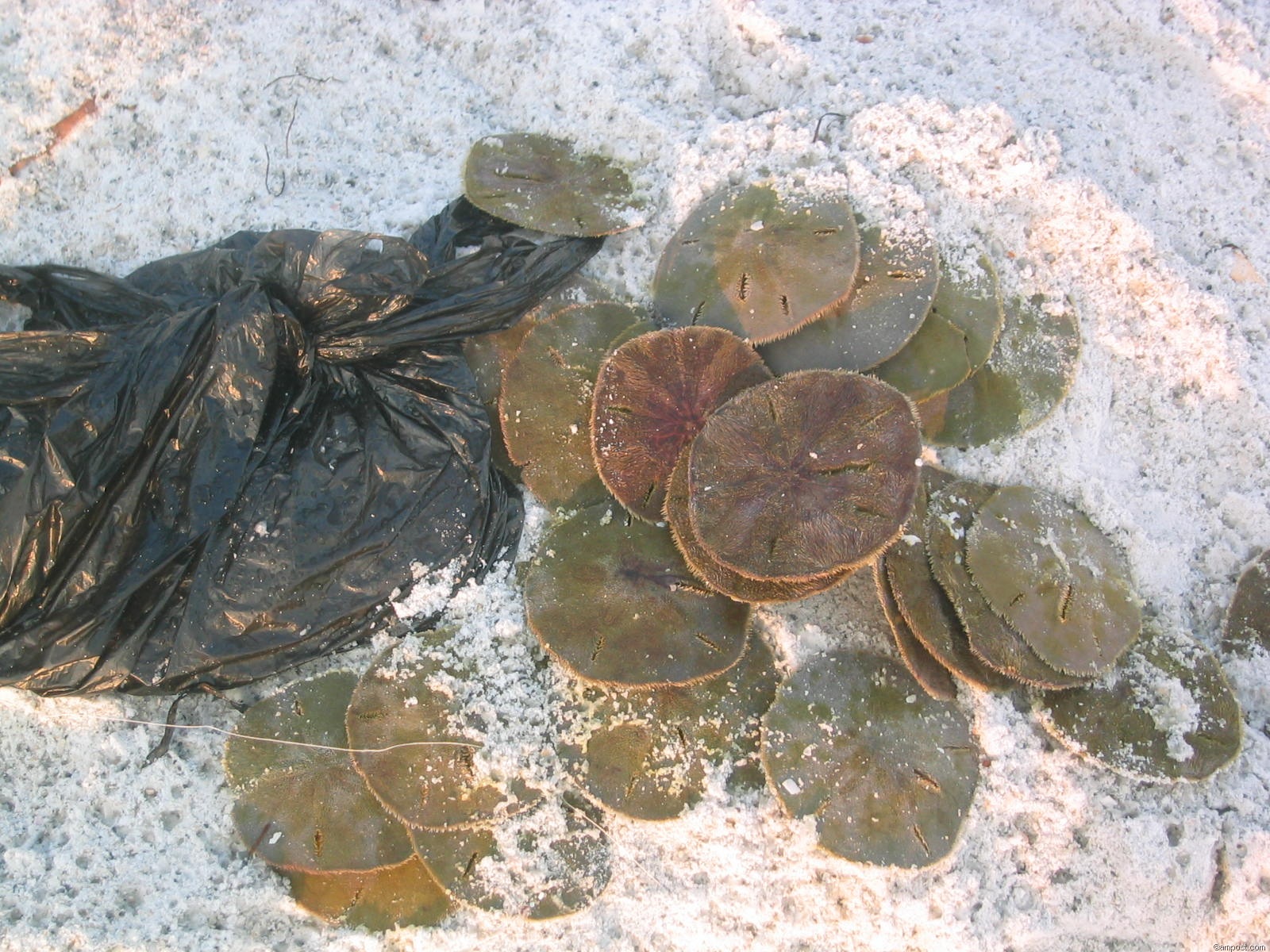
Illegally collected live Sand Dollars discarded on beach

Sand dollars are not even beautiful when they are alive. Their whiteness comes only after the outer layer of skin and small spines has disappeared. It is the endoskeleton that is beautiful. I’m sure trying to clean a live sand dollar is not worth the smelly effort. It makes no sense to kill these creatures.

This member of the sea urchin family has the five sections of a sea urchin, but a flattened form. The very small spines allow it to move along the sandy bottom of the sea, and to burrow in. They also move food into the mouth. They eat mostly crustacean larvae, algae, diatoms and detritus.

A few years ago, scientists discovered something remarkable about sand dollars. They reproduce sexually, through external fertilization. However, their larvae have the ability to clone themselves and are likely to do this when threatened by a predator. The outcome is twice the number of larvae, with each one half the size. In some ways this is advantageous from a survival point of view.

Aside from general ethical reasons not to kill living creatures unnecessarily, there are laws in Manatee County, backed by the state of Florida, in relation to taking live shells. First of all, one must have a recreational salt water fishing license. And then only two of any particular species may be taken alive. There are some exceptions, such as oysters, several kinds of clams and coquinas, which may be taken in larger numbers.

Categories
Environment

2010 Atlantic Hurricane Season Forecast

{openx:1}

The official start to the Atlantic Hurricane Season is June 1st. Now is a good time to make preparations for an emergency evacuation and formulate your disaster plan, check your insurance, storm shutters, and put together emergency supplies.

The Department of Atmospheric Science at Colorado State University has published its forecast for the Atlantic basin 2010 hurricane activity, based on over 58 years of past data and predictive statistical analysis. Early season forecasts are for the following:

Atlantic Hurricane SeasonApril 2010 forecast1950 – 2000 average
Named storms (>35mph)159.6
Hurricanes (>72mph)85.9
Major hurricanes (>111mph)42.3
US landfall likelihood69%52%
Gulf Coast landfall45%31%

According to forecasters Philip J. Klotzbach and William M. Gray, “We continue to foresee above-average activity for the 2010 Atlantic hurricane season. We have increased our seasonal forecast from the mid-point of our initial early December prediction due to a combination of anomalous warming of Atlantic tropical sea surface temperatures and a more confident view that the current El Niño will weaken. We anticipate an above-average probability of United States and Caribbean major hurricane landfall.” (as of 7 April 2010) For the full report click here.

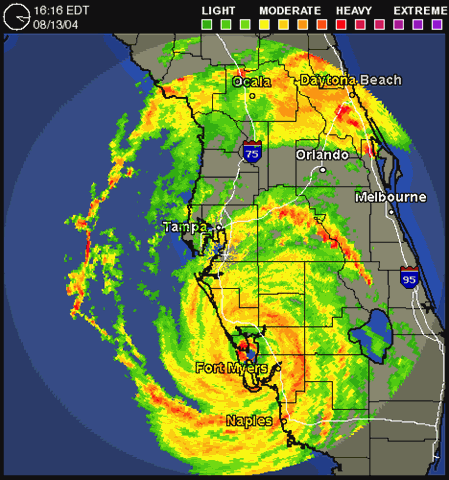
Hurricane_Charley_Loop_FullThe active year of 2005 and Hurricane Katrina may have passed into memory, and the past few years have seen quiet seasons for the Florida Gulf Coast even as a record breaking two intense Category 5 hurricanes made landfall in Mexico 2007. In 2004 Hurricane Charlie over-washed North Captiva Island, causing major damage there and Charlotte Harbor surroundings. Although not far away, Anna Maria Island was unaffected by Charlie’s small but heavy footprint.

The frequency of hurricanes may have declined over the last 44 years but the intensity of storms has increased. Now with a much larger population and more dense development, Florida and the Sun Coast is more vulnerable to the effects of hurricanes than ever before.

Check your local and regional papers for hurricane preparedness information and tips that come out at this time of year, and know your evacuation routes and destination. Find a location that is not subject to flood zone evacuation advisories and as near as possible in order to avoid being trapped by traffic congestion and clogged roads. Avoid using public shelters, which will be over-crowded and under-serviced. See flood zone and shelter information for Manatee County or the telephone book for a map.

Major Hurricanes 1922-2009Anna Maria Island’s three bridges to the mainland will all be closed at some time in a major storm, preventing egress of residents or entrance by emergency services. Consider the ramifications of ‘riding out the storm’ or trying to return when there is no power, water, or communication, perhaps for many days or weeks.

Review your insurance policies and gather important papers ready for evacuation. Home owners’ insurance does not cover damage from rising waters but NFIP offers taxpayer-subsidized flood insurance policies. If a named storm is in the area insurance policies will not be issued therefore get prepared well in advance.

{openx:4}

Remember that residents of Holmes Beach must obtain a hanging tag for re-entry after evacuation.

Categories
Tourism

Cruising Tropical Seas

Although not technically in the tropics, Anna Maria Island is close enough to have some tropical features. Many tropical plants grow here, and plenty of tropical storms come here. Many a tropical drink is enjoyed here! Sailing in warmer months certainly is a tropical experience. The friend who invites us to sail always offers the opportunity to cool off with the on-board spray, or with a swim in a pool back at the deck. It’s hot. It feels tropical.

The other day we were cruising Tampa Bay in a very stiff breeze. Gusts registered at 30 knots. We managed to eat our delicious Cuban sandwiches prepared by the ‘Havana Cabana’, despite the heeling of the boat and the tension on the reefed mainsail. We had left the jib down. Memorable as the sandwich and strong wind were, what struck me the most was the color of the water. It was such brilliant turquoise. I could not remember having seen it this color in recent sails. It made me feel as if we were in a tropical place. I wondered whether this is, indeed, the color of tropical seas. I wondered whether this always was the color of Tampa Bay, but I had just forgotten.

This led me to do a fair amount of reading on-line about the color of water. I confess that even after doing all this reading, I do not understand all the very complicated scientific explanations that were involved. These included discussions of the fact that the color of water is based on vibrations of molecules, and that some of the color is caused by reflection, refraction, and some of it is caused by absorption.

Cruising tropical Gulf of Mexico The simple fact that surprised me most, and which I was capable of understanding, was that water actually has an intrinsic blue color. I used to think the blue was entirely from reflection of the sky.

Proof that the color is intrinsic to the water can be seen by looking at water in an indoor pool with white sides and bottom. It looks blue. At least I think this is the case, based on what I read.